
Content Marketing
Hey, I’m Rutba — building a space where anyone can learn digital marketing for free.
Understanding Content Marketing
We’re all drowning in ads—pop-ups, sponsored posts, those weirdly specific Instagram reels that somehow know you want new sneakers. It’s relentless. But content marketing? That’s like a breath of fresh air in the middle of all that noise.
Instead of yelling, “BUY THIS NOW!” in your face, content marketing is more like, “Hey, here’s something actually useful. Let’s vibe a bit.” You know?
So, what’s the big deal with content marketing anyway? Why are people saying it’s running the show online now? Lemme break it down without the fluff.

🧠 What Even Is Content Marketing?
Okay, textbook definition time (don’t worry, I’ll keep it chill): Content marketing is basically making stuff people actually wanna read, watch, or listen to—stuff that helps them out, makes them laugh, or answers their questions. The goal? Get folks to trust you, remember you, and eventually, yeah, buy from you. But you’re not being a pushy jerk about it.
Think about two shoe brands for a second:
Brand A is blasting TV ads with some celebrity screaming, “LIMITED OFFER, BUY NOW!”
Brand B is dropping blog posts like “10 Ways To Avoid Knee Pain” and YouTube vids on picking the best running shoes.
Who do you trust more? Yeah, me too. That’s content marketing doing its thing.
🌐 Content Is Everywhere—Seriously, Everywhere
Scroll your feed for two seconds. Blogs, memes, TikToks, podcasts, you name it. Content is the glue sticking brands and people together. Instead of shoving a product down your throat, good content says: “Here’s something cool, no strings attached (well, maybe later, but not right now).”
Why Content Marketing ?
- Shows you’re not a robot
- Pulls people to your website (hello, traffic)
- Turns random scrollers into fans, then fans into people who actually buy stuff
| Traditional Ads | Content Marketing | |
| Goal | Sell, sell, sell | Build trust, connect |
| Where ? | TV, radio, print | Blogs, TikTok, Insta |
| Tone | “Listen to us!” | “Let’s chat” |
| Style | Interruptive | Actually helpful |
Content marketing is kinda like dating. You get to know someone, chat, share a few laughs. Traditional marketing? That’s proposing on the first date. Yikes.
🚀 Why Content Is a Big Freakin’ Deal
1. 🧱 It Gets Your Name Out There
Standing out online is brutal. Good content—think guides, hacks, or even just funny tweets—makes people remember you. Like, “Oh yeah, that skincare brand with those cool tips? I trust them.”
2. 📣 Gets People Talking
People love sharing stuff that hits home. The brands killing it (Nike’s hyped-up videos, Zomato’s savage tweets) aren’t just selling—they’re joining the convo, starting trends, dropping punchlines. Suddenly, you’ve got a squad, not just customers.
3. 🛡️ Builds Trust (And That Means Sales Later)
If you’re giving away genuinely helpful info—say, a finance blog breaking down taxes or investment hacks—folks will see you as the go-to. Next thing you know, they’re signing up for your premium thingamajig without a second thought.
📚 How Content Marketing’s Changed (Spoiler: A Lot)
This isn’t some new-fangled internet thing. John Deere was publishing farmer magazines over a hundred years ago! But now? The game’s wild.
- 90s/00s: Blogs blew up. Anyone could have a voice.
- 2010s: Social media, YouTube, Insta stories. It’s a content frenzy.
- Now: TikTok, Reels, AI-powered everything, influencer collabs, content customized just for you. Blink and you’ll miss a trend.
Tech’s made it so content zips around the globe in seconds. Brands can reply to you instantly on Twitter, go live on Insta, or drop a meme that breaks the internet. Heck, even AI is cranking out content now (no comment on whether that’s a good thing).
So, it’s not just about writing a blog anymore. It’s reels, infographics, interactive quizzes, and whatever comes next. The pace is nuts, but the upside? If you nail it, your brand can go from nobody to everywhere—fast.
🧠 Real Talk: Why Should You Even Care?
If you’re building a brand, and you’re NOT doing content marketing, you’re basically yelling into the void. You want people to trust you, remember you, and yeah—buy from you eventually? You gotta give them something worth their time first.
Don’t be the person at the party shouting about your product. Be the one sharing funny stories, dropping knowledge, and actually listening. That’s content marketing. And honestly? It works.
Types of Content Used in Marketing
Learn how to measure the performance of your content
Alright, let’s chuck the corporate jargon and get real about content marketing. Everybody talks about “what” and “why,” but honestly, the “how” matters just as much. The format you pick isn’t just a box to check—it straight-up decides if people pay attention or just keep scrolling.
Different stuff does different jobs. Some content gets new eyeballs on your site, some keeps folks around, some builds trust, and—let’s be real—the best kind convinces people to actually do something (like, you know, buy your stuff). If you know what each piece is good for, you can mix things up and not sound like a robot on autopilot.
Let’s tear into the types:
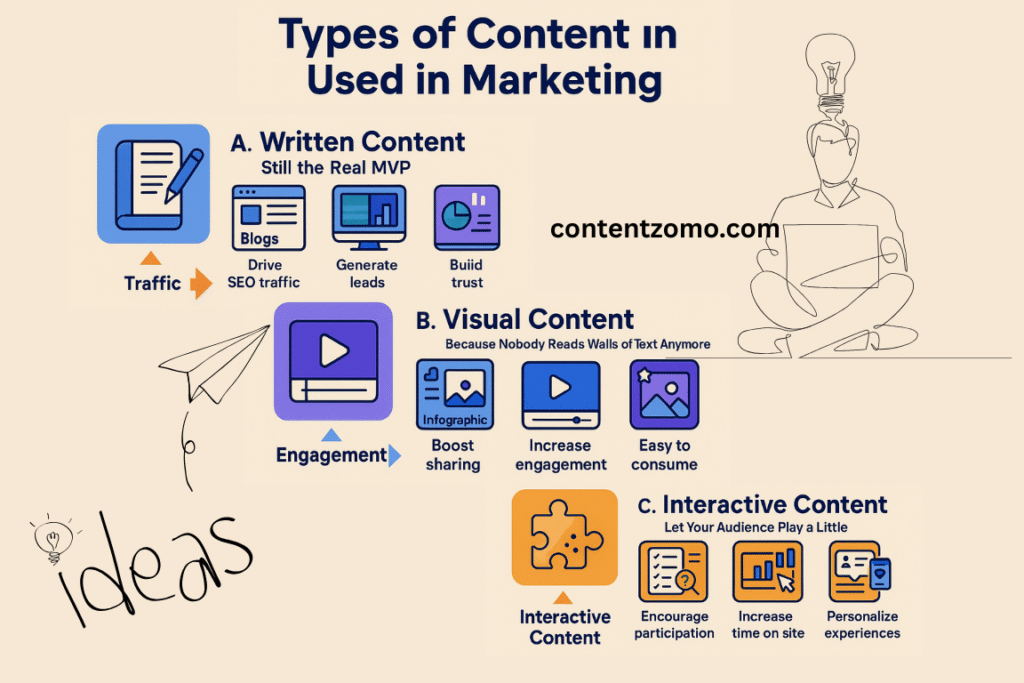
✍️ A. Written Content: Still the Real MVP
Yeah, everyone’s drooling over video right now, but words aren’t dead. Written content is still the backbone of most digital marketing moves. It’s flexible, Google eats it up, and it’s way easier to share than you’d think.
1. Blogs and Articles
This is your bread and butter. Blogs are everywhere because they just work.
- They climb Google rankings if you’re smart with keywords
- Teach your audience something useful
- Bring you traffic that sticks around for months or even years
Why bother? Well, Google’s obsessed with new, helpful info, and blogs are perfect for answering all those weird questions people type at 2 a.m.
For example: A fitness brand drops a post like “5 Exercises to Fix Your Slouch” or “Best Pre-Workout Snacks for Newbies.” People find it, read it, trust you more. No hard sell, just vibes.
2. E-books and Whitepapers
Now we’re getting a little nerdy. These are the deep dives. Not just a quick read—these are for folks who want all the info. Usually, people trade their email for this, so you’re also beefing up your email list.
Why do they rock?
- Show you actually know your stuff
- Score leads you can actually follow up with
- Build a stash of smart resources
Picture this: A cybersecurity company drops a whitepaper called “2025 Cyber Threats—What You Need to Know.” You want it? Gotta give up your email. Classic move.
3. Newsletters
Ah, the humble email newsletter. People say email is dead, but come on—everyone checks their inbox, even if it’s just to delete junk. Newsletters keep you in people’s brains. Use ’em to:
- Share updates, deals, or cool stuff
- Push out new content
- Nurture relationships so folks don’t forget you exist
Why? Because you’re landing right where they’ll see you. Perfect for keeping leads warm or making customers feel special.
Example: A SaaS business sends out monthly emails with hacks, new features, and winning stories from users. Friendly, helpful, not annoying.
🎨 B. Visual Content: Because Nobody Reads Walls of Text Anymore
Visuals are just easier on the brain. They’re punchy, memorable, and way more likely to get shared. Especially if your audience is scrolling at the speed of light.
1. Infographics
It’s like, “Look, here’s a bunch of info, but pretty.” They mix graphics and bite-sized text so people actually get it.
Why bother?
- Share updates, deals, or cool stuff
- Push out new content
- Nurture relationships so folks don’t forget you exist
Example: A health site makes an infographic called “What Sugar Does to Your Body in a Day.” Boom—science, but make it TikTok-friendly.
2. Videos
Honestly, if you’re not making videos, what are you doing? From how-tos to behind-the-scenes, video is where the people are.
Why’s it killer?
- Hits you emotionally and logically
- People remember what they see and hear
- Gets you more clicks, views, and probably sales
Example: A clothing brand films where their eco-friendly fabrics come from. Suddenly, you’re not just buying socks—you’re saving the planet. Kinda.
3. Images & Custom Graphics
Don’t just dump text on people. Add images, illustrations, memes—whatever matches your vibe. It makes everything pop and helps your brand stand out in a sea of sameness.
Why use ’em?
- Breaks up boring text
- Catches eyes on social
- Makes info less snooze-worthy
Example: Marketing agency shares a carousel on Instagram: “5 Quick Wins for Your LinkedIn Profile.” Easy to swipe, easy to save, easy to flex.
🧩 C. Interactive Content: Let Your Audience Play a Little
This is next-level stuff. Instead of just shoving info at people, you actually get them involved. It’s like, “Hey, wanna click this and see what happens?” People love it. Also, you get data. Win-win.
1. Quizzes & Surveys
People are nosy about themselves. Quizzes make them stick around, and you get to learn what they like or want.
Why’s it work?
- Breaks up boring text
- Catches eyes on social
- Makes info less snooze-worthy
Example: A travel site makes a quiz: “What’s Your Dream Vacation?” You answer, they recommend a trip. Feels personal, super shareable.
2. Interactive Infographics
Static is so last year. Let users click, scroll, or hover to explore data. It’s almost like a game.
Why bother?
- People pay more attention
- They stay on your site longer
- Exploring is fun—who knew?
Example: A tech brand does an interactive graphic called “Inside a Smartphone.” Click around, learn stuff, and feel smarter than your friends.
And that’s the gist. Mix it up, keep it fresh, and don’t be afraid to experiment—nobody ever shared a boring wall of text.
Strategies for Effective Content Marketing
🎯 How to Actually Build a Smart Content Marketing Gameplan (Without Losing Your Mind)
Look, making killer content? That’s just the start. If you want your stuff to actually matter, you gotta have a system. I’m talking: Who’s it for? What are you saying? Where’s it landing? Without that, you’re basically shouting into the void.
So here’s what really matters—let’s break it down, no fluff:
A. Audience Research: Don’t Guess, Actually Know Who You’re Talking To
Trying to please everyone? Congrats, you just pleased no one. The good stuff? It’s targeted. It’s like, laser-beam focused on a specific crowd—their issues, what keeps them up at night, what they wanna see on their feeds.
Step 1: Who the Heck Are You Making This For?
Start simple: “Who’s actually gonna care about this?”
You need to know:
– Age, gender, zip code, bank account (well, maybe not the last one, but you get it)
– What they value, what they do for kicks, what makes them tick
– How they behave online: what they’re googling at midnight, what they’re sharing, what they ignore
Say you’re selling eco-friendly cleaning sprays. Your crowd? Probably:
– Age 25–45, hates toxins, probably has a toddler or two, big on Insta and Pinterest, obsessed with “sustainable hacks”
If you don’t have this locked down, you’re just throwing spaghetti at the wall.
Step 2: Use Actual Data, Not Vibes
Nobody’s got time for wild guesses. There’s a mountain of tools to spy (nicely!) on what your audience wants:
– Google Analytics: Where’s your traffic coming from? What’s popping off?
– Meta Insights: Your Facebook/IG crowd—who are they really?
– SEMrush, Ahrefs: What’s your audience typing into the search bar?
– AnswerThePublic: Real questions from real humans (not just bots)
– Hotjar: See what people are actually doing on your site. Creepy? A little. Useful? Heck yes.
Here’s why it matters: If 80% of your visitors are on mobile and reading how-to’s, why are you still writing desktop-only think pieces? Meet people where they are.
Step 3: Make Up Some People (But Make Them Real)
You need buyer personas. Give them names (seriously—“Eco Emma” is a thing), jobs, pain points, goals, their favorite platforms, even how tight they are with their wallets. Don’t try to please all the personas on earth—pick like two or three and go all in.
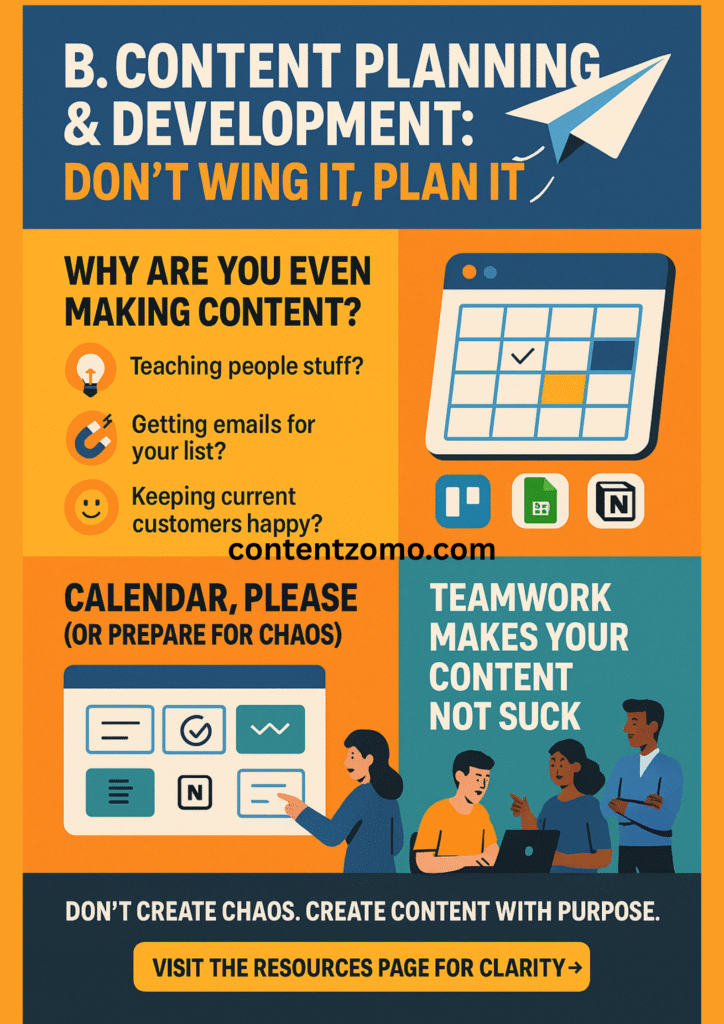
B. Content Planning & Development: Don’t Wing It, Plan It
Cool, you know who you’re talking to. Now, what are you actually gonna say? If you just post “when inspiration strikes,” good luck. You need a plan.
1. Why Are You Even Making Content?
Every post, video, meme, or newsletter needs a job. Are you:
– Teaching people stuff?
– Getting emails for your list?
– Driving them to your site?
– Keeping current customers happy?
For example, a blog called “How to Start a Home Yoga Habit” could be:
– For newbies (awareness)
– With a link to download your free yoga guide (lead gen, baby)
If you don’t know the goal, you can’t tell if it worked.
2. Calendar, Please (Or Prepare for Chaos)
A content calendar is your friend. It tells you:
– What’s going live
– Where it’s going
– Who’s in charge
– When to hit “publish”
Tools? Take your pick:
– Trello or Notion if you love checklists
– Google Sheets if you’re old-school
– CoSchedule/HubSpot if you want the fancy stuff
Pro tip: Use monthly themes—like “Eco January” or “Back-to-School September”—so you’re not just scrambling for ideas.
3. Teamwork Makes Your Content Not Suck
Don’t do this alone. Sales knows what people complain about. Designers make things pretty. Customer service? They’ve heard it all. Mix up the perspectives, and suddenly your blog isn’t just another boring sales pitch.
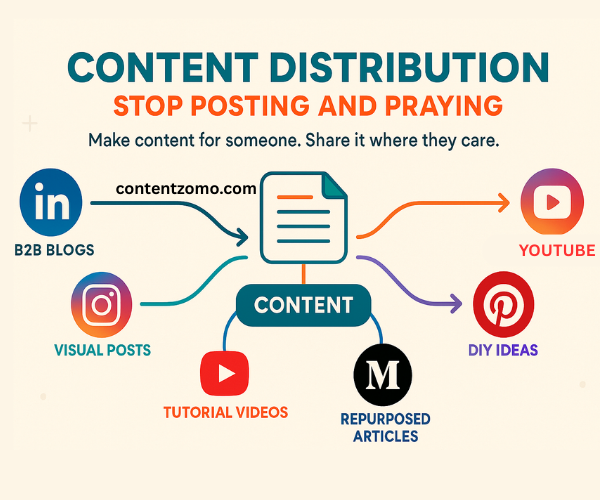
C. Content Distribution: Stop Posting and Praying
Made something awesome? Sweet. Now, how do you get people to actually see it? If your distribution plan is “post and hope,” you’re setting yourself up for crickets.
1. Pick Your Platforms Like You Pick Your Outfits (Carefully)
Not all content belongs everywhere. Choose based on:
– Where your people hang out
– What kind of stuff you made
– What you’re trying to accomplish
Quick rundown:
– LinkedIn: Nerdy B2B stuff—blogs, whitepapers, thought-leader rants
– Instagram: Pretty pictures, product drops, tips you can swipe through
– YouTube: Tutorials, explainer vids, long-form deep dives
– Pinterest: DIY, life hacks, stuff people save for later
– Medium: Repurpose your long blogs and meet a new crowd
2. Social Media: Not Just for Cat Memes
(…and that’s where you left off, but you get the vibe.)
Bottom line? Don’t just make content. Make it for someone. Plan it. Actually share it where people care. And hey, have some fun with it. The internet’s got enough boring already.
Measuring Success in Content Marketing
Alright, let’s get real—just tossing content out into the internet void and hoping for the best? That’s like driving cross-country with your eyes closed. You might get somewhere, but…good luck explaining that to your boss. If you care even a little about results, you gotta measure what’s actually happening out there.
So, how do you know if your blog post or video isn’t just collecting digital dust? You dig into the numbers and, honestly, sometimes the brutally honest feedback from people who don’t care about your feelings. That’s where the magic (and sometimes pain) happens.
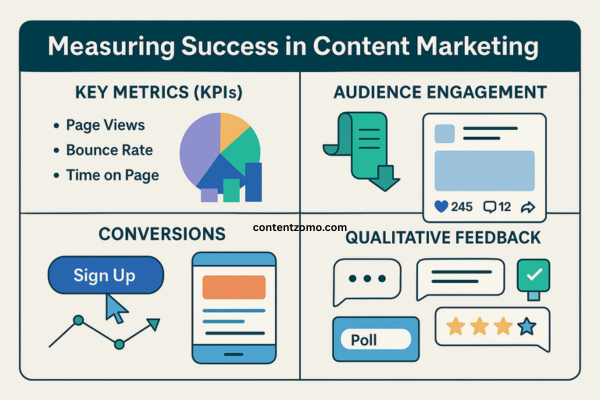
A. 📈 What Actually Counts: KPIs, Baby
KPIs—fancy way of saying “the stuff that matters.” It’s not just about feeling good that you hit ‘publish.’ Are people clicking? Sticking around? Sharing it with their group chat? That’s what you need to know.
Let’s break down some real-deal metrics:
- Page Views – Basic, but hey, at least you know someone found your stuff.
- Unique Visitors – Did your mom refresh the page 30 times or are those actual humans?
- Time on Page – If folks are hanging out, you’re doing something right.
- Bounce Rate – If everyone’s ghosting after two seconds, something’s off.
- Shares & Likes – If people are tossing your content around social media, gold star for you.
Example from the trenches: Say a skincare brand drops a blog on “Best Night Routines for Oily Skin.” Two days later? 15,000 page views, over three minutes average read time, 3,500 Instagram shares, and a bounce rate that’s basically a humble brag at 27%. That’s fire.
But wait—just because people click doesn’t mean they care. Engagement is the real juice.
B. 🚨 Are People Actually Engaged or Just Scrolling?
Clicks are cool, but do people *care*? Are they leaving comments? Clicking your links? Coming back for more? Scroll depth is underrated—did they make it past the headline or just bail?
Like, this SaaS company noticed one post got way more comments and people actually scrolled all the way down. So, they doubled down on that vibe in future posts. Spoiler: it worked.
And let’s talk conversions. Because, yeah, eyeballs are nice, but are you getting what you want—sign-ups, downloads, cold hard cash? HubSpot once spent 3k on a template, pulled in 20,000+ leads in half a year. That’s almost unfair.
Pro tip: Use UTM links and set up goals in Google Analytics, otherwise you’re just guessing.
C. 🧏♂️ The Stuff You Can’t Measure With a Spreadsheet
Numbers only tell you so much. Sometimes you need to get your hands dirty and read through the comments, emails, or those weird DMs you get at 2am. People will straight up tell you what’s missing—like, “Cool article, but where’s the video?” Turns out, adding that video can bump your engagement way up. Actual example: one company added a YouTube walkthrough after feedback and saw a 27% jump in time-on-page.
Surveys, polls, quick feedback forms—super easy, super useful. Ask people what sucked, what they want next, or if they even found what they came for. Sometimes you get gold, like “add budget tips for solo travelers,” then you do it, and boom—your next post blows up.
But only an amateur ignores feedback. If you see people leaving halfway through, or video is crushing it over text, or your CTA is getting the cold shoulder, don’t just sit there. Change it up. Even little tweaks—better headlines, more visuals, less corporate blah-blah—can make a huge difference.
D. 📊 Don’t Just Stare at Data—Do Something
Here’s the deal: the best brands don’t just stare at their analytics dashboard like it’s a crystal ball. They test, measure, learn, and actually do something about it. Got Google Analytics? Great. Heatmaps from Hotjar? Even better. But if you never change anything, what’s the point?
So yeah, keep your finger on the pulse. Listen to your audience, measure what matters, and don’t be afraid to shake things up. The internet’s a moving target—aim carefully, but don’t be afraid to fire off a few wild shots. That’s where the good stuff happens.